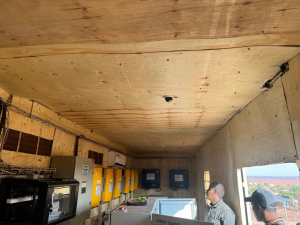
2.1 Garissa Solar Plant 54.6 Mw (-0.33434, 39.60610)
2.1.1 Construction costs, funding and commissioning
2.1.2 Scope of works
The project scope of work included: Construction of a 132KV bay at 132/33/11KV Ketraco Substation; Installation of a 50 KW (Installed capacity is 54.65MW) solar generation plant complete, with Solar panels (206,232no panels of 265Wp), step up transformers and 33no x 0.415/33kV transformers; Construction of 5.7 km of 132KV transmission line with 16No. pylons (Towers) from the Solar Plant to Ketraco Substation; Construction of a 33# 0.415/33 KV substation at the Solar Plant and a 50 MVA 33/132KV step up transformers; Indoor 33kV switch room and control room for monitoring; CCTV installations for monitoring.
The following support facilities were also developed: Staff housing; Borehole with water treatment plant; Sewage treatment plant; Office block with a training and recreational centre; Road network; Weather station and Perimeter wall enclosing the whole plant
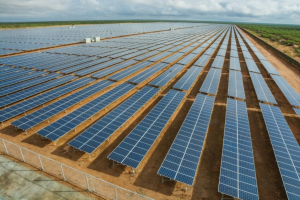 An aerial view of the Solar panels at the plant
2.1.3. Output and Power Purchase Agreement (PPA)
2.1.4. Transfer of O&M function to KenGen
2.1.5Future Prospects
2.2 Solar Mini-grids
2.2.1 GoK Funded Solar Mini-grids
2.2.1 GoK Funded Solar Mini-grids
The corporation has implemented Twenty-Seven (27) solar mini-grids across counties of Wajir, Turkana, Marsabit, Mandera and Garissa. The projects consist of solar PV system with battery staorage and a back-up diesel generator to ensure quality and reliable power supply to the customers.
The projects are serving in excess of 3,693 customers including public facilities and provide other socio-economic benefits to communities living in these areas in education, health, entrepreneurship, employment, communication, water pumping and food preservation. This translates to major carbon emission reduction for the country because previously the connected customers used kerosene or biomass fuel as a source of light.
The Corporation is currently implementing a 150kW solar mini-grid with battery storage in Dadajabula town, wajir county and a 100kW solar mini-grid in Kibuogi Island, Homa Bay County. Once commissioned the projects will provide reliable power supply to approximately 350 homesteads, institutions and businesses in the towns and villages.
County Sites and Ratings
| # | County | Site | Constituency | Rating (kW) |
|---|---|---|---|---|
| 1 | Marsabit | Ambalo | Moyale | 60 |
| 2 | Marsabit | Illaut | Laisamis | 60 |
| 3 | Marsabit | Balesa | North Horr | 60 |
| 4 | Turkana | Eliye (Ille) Springs | Turkana Central | 60 |
| 5 | Turkana | Lowareng | Turkana North | 60 |
| 6 | Turkana | Letea | Turkana West | 60 |
| 7 | Turkana | Lopeduru | Turkana East | 60 |
| 8 | Turkana | Kangangipur | Turkana South | 60 |
| 9 | Turkana | Napelilim | Loima | 60 |
| 10 | Garissa | Sangailu | Ijara | 60 |
| 11 | Garissa | Liboi | Dadaab | 60 |
| 12 | Garissa | Eldera | Lagdera | 60 |
| 13 | Garissa | Garsweino | Fafi | 60 |
| 14 | Mandera | Kiliwehiri | Banissa | 60 |
| 15 | Mandera | Burduras | Mandera West | 60 |
| 16 | Mandera | Gari | Lafey | 60 |
| 17 | Mandera | Shimbir Fatuma | Mandera South | 60 |
| 18 | Mandera | Ashabito | Mandera North | 60 |
| 19 | Mandera | Arabia | Mandera East | 60 |
| 20 | Wajir | Biamadhow | Wajir North | 60 |
| 21 | Wajir | Gurar | Wajir North | 60 |
| 22 | Wajir | Hadado | Wajir West | 60 |
| 23 | Wajir | Sarif | Wajir South | 60 |
| 24 | Wajir | Basir | Eldas | 60 |
| 25 | Wajir | Riba | Wajir East | 60 |
| 26 | Wajir | Sarman | Tarbaj | 60 |
| 27 | Wajir | Buna | Wajir North | 280 |
| 28 | Wajir | Dadajabula | Wajir South | 150 |
| 29 | Homa Bay | Kibuogi Island | Suba South | 100 |
| TOTAL | 2,150 | |||
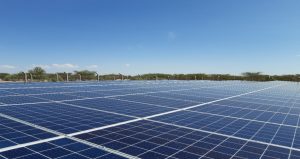 Fig 1-Kangangipur Solar Minigrid
2.2.2 Donor Funded Solar Mini-grids – KEMP
2.2.3 Donor Funded Solar Mini-grids - KOSAP
2.3 Solar Water pumping
2.3.1 GoK Funded
The Corporation in Collaboration with Kisumu and Nyeri county governments have implemented a solar water pumping project in 23 boreholes which were initially powered by grid or diesel generators. Some of the boreholes were not operational because they had been disconnected from power supply due to pending bills or the cost of running the diesel generators was too high. The solarization of the boreholes has been transformational to the community in many ways.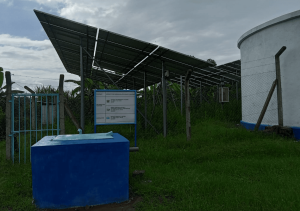
Fig 2:Nyeri borehole
2.3.2 Donor Funded Under the KOSAP program, the corporation is solarizing 316 boreholes in fourteen (14) counties. They include;
2.4 Solar High Masts and Street lighting
In line with Government BETA plan of promoting 24hour economy, REREC initiated a program to light up public places through solar powered street lights and high masts.
Solar street lights and high mast flood lights play a critical role in providing safety and promoting security in urban and in remote areas that don’t have access to a conventional electrical grid. Solar street lights offer great cost savings to the Counties as there are no power bills to be paid and require much less maintenance compared to conventional street lights. They are also social economic transformational because the beneficiary markets enjoy extended business hours.
The Corporation has installed 714 grid connected high masts, 354 solar powerd high mast, 4,436 grid connected street lights and 4,750 solar street lights in various parts of the country in collaboration with the counties.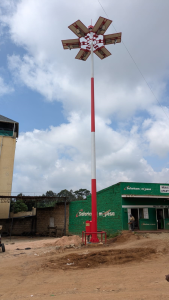
Fig 3: Solar highmast
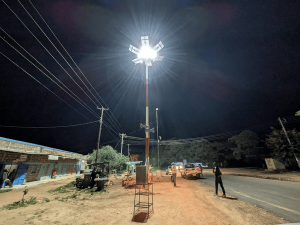
Fig 6: Solar streetlights
2.5 Solar for schools
The Corporation was mandated to undertake electrification of all primary schools which didn’t have power supply to facilitate the government Digital Learning Programme. As part of its support to program, the Corporation has provided solar powered electricity to 4,860 primary schools and 76 secondary schools.
The primary schools were installed with 1.8kW solar PV system while the secondary schools are installed with 3kW syatem. The Corporation has since adopted use of lithium-ion batteries which are more robust and a longer life span. Over the period 2,441 schools have been mantained
These projects have been a great support to education in the beneficiary schools because the students are able to contact evening studies more conveniently. This is expected to significantly improve the performance of the beneficiay schools. Teaching primary puipils digital literacy skills is very important because they need to be able to understand the technology that they use so that they can use it safely and effectively. In additions, this prepares them to future careers which will majorly digital.
2.6 Diesel power station and solar hybridization
2.7 Mini-grids upgrade
Most of the mini-grids have been in operations for over 5 years and therefore the batteries have reached their end-life and are due for replacement. The towns supported by the mini-grids have also grown very fast due to presence of electricity and in some cases the demand has increased beyond the power plants capacities.
The Corporation has upgraded two mini-grids (Liboi and Ashabito) and replaced batteries in Arabia. The Corporation has also provided funding for the upgrade and battery replacement of 23 solar mini-grids in the 2024/25FY.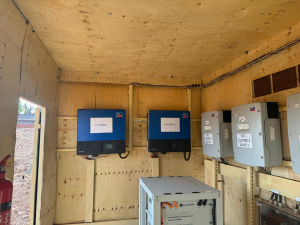
Fig 7: Battery replacements at Arabia
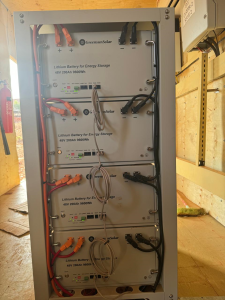
Fig 8: Battery replacements at Arabia